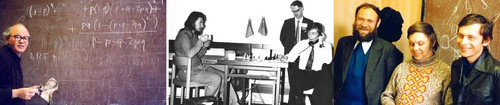
https://greko.su/index_en.html
Kaissa Chess Engine - WinBoard Protocol/Console Version
Based on the original Turbo-C Kaissa Chess Engine (1992)
Ported to modern systems by Jim Ablett 18-04-26
Kaissa (the legendary goddess of chess) was a Soviet chess program that dominated international computer
chess from 1974 to 1977. Kaissa made use of a pruning technique called "the method of analogies," meaning
postions that were so alike that the same score could be attributed to all. Kaissa was revolutionary in its
use of analogous positions and tree searching methods for reductions of computational load. The original
program was written by Vladimir Arlazasov, Alexander Bitman (Russian national chess master).
In 1990, the legendary Soviet chess program Kaissa was rewritten to run on the IBM PC by a
nine-member team led by Mikhail Donskoy.
Kaissa evolved from the Institute for Theoretical and Experimental Physics (ITEP) and the Institute for Systems
Science in Moscow, headed by mathematician Georgi Adelson-Velskiy. The program had an Elo rating around 1600.
Kaissa evolved from a chess program used in a USA-USSR computer chess match in 1967 in which the USSR program
defeated the Stanford program. In 1971 Donskoy began work on the new program, written in Assembly.
Kaissa ran on a mainframe (British ICL System 4/70 computer) equipped with a 64-bit processor. 64 is also the
number of squares on a chessboard, so it was possible to use a single memory word to represent a yes-or-no or
true-or-false predicate for the whole board. This was called the bit board. The ICL 4/70 computer had 24,000
bytes of memory. It enabled the program to evaluate 200 positions per second. It could store 10,000 opening
positions in its memory. The program was written in Assembly language. The Assembly code occupied 384K bytes
(8-bit words). The Russians would have had a more powerful chess program if it had used an IBM machine, but they
were not allowed to buy or use one. The speed of the ICL 4/70 was 900,000 instructions per second.
Kaissa was a Shannon type A program that search 7 ply full width, with extensions for captures, checks, and forcing
moves. The program employed the alpha-beta technique with a "window." The program introduced a feature called
"best move service," storing a table of the 10 best moves. This was used to improve move ordering for the alpha-beta
method. Another feature was a "dummy move," in which one side does nothing at its turn and used to discover threats.
History & Legacy:
Originally developed in the late 1960s, Kaissa became the first World Computer Chess Champion
in 1974. Development was officially halted by the Soviet government in the early 1980s, but the
team later reunited under the company Paragraph (and later DISCo) to bring the engine to the personal
computer market.
PC Version Details:
Performance: The 1990 PC version debuted at the 2nd Computer Olympiad in London, where it shared fourth
place out of eleven participants, achieving four wins and two losses.
Technology: It was written in Turbo C. While earlier versions ran on massive mainframes like the IBM 370/165,
the PC version was optimized for IBM-compatible hardware.
Innovations:
The PC version retained the classic algorithms that made Kaissa famous, including the first use
of bitboards, null-move heuristics, and permanent brain (thinking on the opponent's time).
Availability:
A 1992 version of the program, including its source code and manual, has been preserved and hosted
online by Vladimir Medvedev, the author of the GreKo engine.
Console mode. Type 'help' for a list of commands.
You play White. Enter moves in long algebraic notation:
e.g. e2e4 or e2-e4 or e7e8q (promotion)
> help → prints the command table
> new → resets board, confirms "You play White"
> e2e4 → plays the move, Kaissa thinks, both moves printed + board
> undo / u → retracts both half-moves (full pair), board restored
> e2-e4 → hyphenated form accepted identically
> switch / sw → swaps sides; engine plays immediately if it's now its turn
> go → forces engine move now, no matter whose turn it is
> time 10 → 10 seconds/move think time
> depth 6 → 6-ply fixed depth search
> show / d → redraws the board
> post/nopost → toggle search output
> xboard → hand off to Winboard protocol
> quit / bye → exits cleanly

Kaissa 64 JA
Windows/Linux & Android profiled builds
Proton link:
https://drive.proton.me/urls/RZKH43K5G4#sDITAW3KmPQi
Smash link:
https://fromsmash.com/Kaissa64JA
Jim.