Mephisto III S Glasgow now as „C“ engine on PC

Discussion of anything and everything relating to chess playing software and machines.

Moderator: Ras

User avatar
mclane
Posts: 19002
Joined: Thu Mar 09, 2006 6:40 pm
Location: US of Europe, germany
Full name: Thorsten Czub

Mephisto III S Glasgow now as „C“ engine on PC

Post by mclane »

In 1984 the programmers Thomas Nitsche and Elmar Henne got the title of Computer world chess champion in a tournament in Glasgow (together with other programmers).

The difference was: Mephisto III computed only few NPS.

The engine came on the market as 8 bit and as 16 bit solution.
On the 8 bit machine it did 1-3 NPS , on the 16 Bit Motorola 12 mhz machine it did 4-10 NPS.

AI and Frank Brenner made it possible that we now have a C engine for the PCs.
He took the original Eprom versions and let the AI reengineer it.

Thomas Nitsche and Ossi Weiner gave their OK to publish it.


In version 1.02 the search depth was optionally increased to 64 plies and hash tables was added.

https://github.com/Admiralatlantis/Scha ... /tag/v1.02


42 years later the engine is reborn for PC.

Image


On the picture from 1979 (!) you can see a very young David Levy operating the Chess Champion Super System MKIII vs. a very young Thomas Nitsche operating a Prototype of Mephisto I in a white color. Left to Thomas Nitsche is Frederic Friedel, the founder of ChessBase and the Publisher of “Computer Schach and Spiele” .
What seems like a fairy tale today may be reality tomorrow.
Here we have a fairy tale of the day after tomorrow....

User avatar
Steve Maughan
Posts: 1353
Joined: Wed Mar 08, 2006 8:28 pm
Location: Florida, USA

Re: Mephisto III S Glasgow now as „C“ engine on PC

Post by Steve Maughan »

Fantastic! Many thanks!

My only comment is: why add a hash table? The whole point of porting IMHO is to the engine as it was, not improve it. Nevertheless a great project.

— Steve
http://www.chessprogramming.net - Juggernaut & Maverick Chess Engine
User avatar
mclane
Posts: 19002
Joined: Thu Mar 09, 2006 6:40 pm
Location: US of Europe, germany
Full name: Thorsten Czub

Re: Mephisto III S Glasgow now as „C“ engine on PC

Post by mclane »

The features are all optional. You can configure it the way it is identically to the original, only much faster of course.
What seems like a fairy tale today may be reality tomorrow.
Here we have a fairy tale of the day after tomorrow....
User avatar
towforce
Posts: 13247
Joined: Thu Mar 09, 2006 12:57 am
Location: Birmingham UK
Full name: Graham Laight

Re: Mephisto III S Glasgow now as „C“ engine on PC

Post by towforce »

mclane wrote: Sat Aug 01, 2026 10:20 am...On the 8 bit machine it did 1-3 NPS , on the 16 Bit Motorola 12 mhz machine it did 4-10 NPS.

This doesn't seem to make sense: what was the computer doing?

Yes - 1984 predates the time when developers started removing knowledge from their engines, because it consumed precious time, reduced Elo rating, and became redundant because as CPUs became faster and more powerful, the game tree would generate much of the knowledge the engine previously had. In the 1990s a majority of developers came to believe that NPS (or depth of search) was a key part of strong play.

Although this predates that time, it's difficult to imagine that an 8-bit engine could hope to have enough static knowledge about enough different position types to be able to compete without a big game tree - so what was going on?
Human chess is partly about tactics and strategy, but mostly about memory
User avatar
Steve Maughan
Posts: 1353
Joined: Wed Mar 08, 2006 8:28 pm
Location: Florida, USA

Re: Mephisto III S Glasgow now as „C“ engine on PC

Post by Steve Maughan »

I downloaded and played with the engine. It's great!

One question: I only got 65k nps on my i7 — why is it so slow? I imagined an engine of this vintage would run in L1 cache at some insane speed, yet 65 knps is slow. Given this and the previous comment about the nps, how is the engine countering nps? Why is it so slow?

— Steve
http://www.chessprogramming.net - Juggernaut & Maverick Chess Engine
User avatar
Eelco de Groot
Posts: 4743
Joined: Sun Mar 12, 2006 2:40 am
Full name:   Eelco de Groot

Re: Mephisto III S Glasgow now as „C“ engine on PC

Post by Eelco de Groot »

65000 positions per second make the Mephisto III seem like some Deep Blue thing. If that is not because of the hash table it is very high. Because it is the Mephisto III

I never had one of the Mephistos but I played against the David Levy computer once (from that picture from Thorsten). I beat it! No chess clock for me so that reduced all the time pressure. Very long ago. With enough time it does not seem impossible. That I could beat it I mean.

Mephisto III will have benefit in the endgame from those hashtables, making it something to be feared for human players like me. 65000 nps!
Debugging is twice as hard as writing the code in the first
place. Therefore, if you write the code as cleverly as possible, you
are, by definition, not smart enough to debug it.
-- Brian W. Kernighan
User avatar
Steve Maughan
Posts: 1353
Joined: Wed Mar 08, 2006 8:28 pm
Location: Florida, USA

Re: Mephisto III S Glasgow now as „C“ engine on PC

Post by Steve Maughan »

I'd be interested in the workflow you used to create the engine. Where did you get the EPROM from? Did it never to be disassembled before passing out over to AI? What was the AI workflow?

— Steve
http://www.chessprogramming.net - Juggernaut & Maverick Chess Engine
User avatar
Eelco de Groot
Posts: 4743
Joined: Sun Mar 12, 2006 2:40 am
Full name:   Eelco de Groot

Re: Mephisto III S Glasgow now as „C“ engine on PC

Post by Eelco de Groot »

towforce wrote: Sat Aug 01, 2026 10:48 pm
mclane wrote: Sat Aug 01, 2026 10:20 am...On the 8 bit machine it did 1-3 NPS , on the 16 Bit Motorola 12 mhz machine it did 4-10 NPS.

This doesn't seem to make sense: what was the computer doing?

Yes - 1984 predates the time when developers started removing knowledge from their engines, because it consumed precious time, reduced Elo rating, and became redundant because as CPUs became faster and more powerful, the game tree would generate much of the knowledge the engine previously had. In the 1990s a majority of developers came to believe that NPS (or depth of search) was a key part of strong play.

Although this predates that time, it's difficult to imagine that an 8-bit engine could hope to have enough static knowledge about enough different position types to be able to compete without a big game tree - so what was going on?
It is pretty much not possible to log in here so I think we will have to wait for another time. Also chessprogramming.org is down as Srdja said and that pretty much only source on the programmers Nitsche and Henne in Google anyway. The AI has no problem because it already read it so if necessary there to go see links. The discussion about Shannon B and Tal with contributions from Tord was nice but bit off topic to the program of course!

This way Talkchess works faster :P

https://www.google.com/search?client=fi ... rogramming

viewtopic.php?t=73418&start=160

https://web.archive.org/web/20240322060 ... 3&start=10


More Talkchess about Shannon B (via chessprogramming.org), and a little mention of Glasgow (that is Mephisto III I think), nice Tord and Chris posts and from our moderator. Fairly recent.

https://web.archive.org/web/20250821235 ... B_Strategy

https://web.archive.org/web/20250816023 ... art=48&f=2

Other archive of chessprogramming.org if the site is in maintenace;

Debugging is twice as hard as writing the code in the first
place. Therefore, if you write the code as cleverly as possible, you
are, by definition, not smart enough to debug it.
-- Brian W. Kernighan
User avatar
Ajedrecista
Posts: 2267
Joined: Wed Jul 13, 2011 9:04 pm
Location: Madrid, Spain.

Re: Mephisto III S Glasgow now as „C“ engine on PC.

Post by Ajedrecista »

Hello:

Thanks for this piece of history.
mclane wrote: Sat Aug 01, 2026 10:20 am[...]

Image


On the picture from 1979 (!) you can see a very young David Levy operating the Chess Champion Super System MKIII vs. a very young Thomas Nitsche operating a Prototype of Mephisto I in a white color. Left to Thomas Nitsche is Frederic Friedel, the founder of ChessBase and the Publisher of “Computer Schach and Spiele” .
I would like to know more about the game. The image was taken from this web and the game was played at Sttuttgart (West Germany then) according to the cutline.

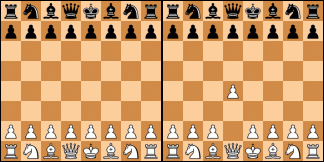
The game looks in the opening phase at the moment of the photo. My guess is:
  • White: Ke1; Rh1; Bf1, Bf4; Nf3; Pd4, Pe2, Pf2, Ph2.
  • Black: Ke8; Qd8; Ra8, Rh8; Bf5, Bf8; Nc6, Nf6; Pa7, Pb7, Pc7, Pd5, Pe7, Pf7, Pg7, Ph7.
With the queenside of the white pieces covered by David Levy (the player of the white pieces if I understood the OP explanation). If my guess is right, black should had played four moves (d5, Nf6, Bf5 and Nc6), so white should had played four or five moves (d4, Nf3, Bf4 and something on the queenside).

Regards from Spain.

Ajedrecista.
User avatar
mclane
Posts: 19002
Joined: Thu Mar 09, 2006 6:40 pm
Location: US of Europe, germany
Full name: Thorsten Czub

Re: Mephisto III S Glasgow now as „C“ engine on PC

Post by mclane »

towforce wrote: Sat Aug 01, 2026 10:48 pm
mclane wrote: Sat Aug 01, 2026 10:20 am...On the 8 bit machine it did 1-3 NPS , on the 16 Bit Motorola 12 mhz machine it did 4-10 NPS.

This doesn't seem to make sense: what was the computer doing?

Yes - 1984 predates the time when developers started removing knowledge from their engines, because it consumed precious time, reduced Elo rating, and became redundant because as CPUs became faster and more powerful, the game tree would generate much of the knowledge the engine previously had. In the 1990s a majority of developers came to believe that NPS (or depth of search) was a key part of strong play.

Although this predates that time, it's difficult to imagine that an 8-bit engine could hope to have enough static knowledge about enough different position types to be able to compete without a big game tree - so what was going on?
On the 8 bit 1802 cmos cpu that hegener and glaser used for the mephisto, that is slower then e.g. a 6502 cpu, mephisto III computed 1-3 NPS. The rest was done statically.

At that time the other 8 bit engines written in assembler did 500-1000 or 1500 nps depending on cpu and frequency.


So mephisto III competed with 1-3 NPS against opponents with 500-1500 nps.

The motorola 16 bit version on 68000 cpu with 12 mhz (but ugly waitstates), did 4-10 nps.

Thomat nitsche and elmar henne were able to win a title with this strange engine.

Of course shared title with richard lang (psion chess), spracklens fidelity, rathsmanns princhess.

www.chesseval.com/WorldChampion/Glasgow1984.htm

The machine they used was commercially availabe as Mephisto III S Glasgow.

The engine was now reengineered by AI and in C compiled for PC and different OS.

Its bugs were repaired (engine crashed in original from time to time in complex positions) , hash tables added and maximum search depth was extended, from 19 to 64.

Thomas Nitsche once explained how his engine worked in this article:

https://www.schach-computer.info/wiki/i ... phisto_III

Quote:

Mephisto III unterteilt den Entscheidungsbaum in 3 Abschnitte
Utopische Züge (gut, falls der Gegner nichts tut):
Eine Stellung kommt in einer Tiefe von etwa 1-3 vor. Der Beginn einer Kombination. Fast jeder irgendwie erfolgversprechende Zug wird selektiert, auch wenn die Wahrscheinlichkeit des Erfolges recht gering ist. Der Mensch nennt manche dieser Züge Opfer.

Optimistische Züge (gut, falls der Gegner nur die zweitbeste Antwort hat):
Die Kombination hat eine Tiefe von 4-8 erreicht. Nur noch Züge mit einer Trefferwahrscheinlichkeit von größer als 30% werden selektiert. I.A. sind dies Züge, bei denen hohe Figuren angegriffen werden, Schach gedroht wird, etc. Diese Züge sollen aber selbst nichts opfern.

Realistische Züge (gut, falls der Gegner den besten Gegenzug wählt):
Die Stellung kommt in einer Tiefe größer als 8 vor. Nur noch klare Abwicklungen werden untersucht. D.h. das Programm greift nicht mehr auf Verdacht an, sondern verfolgt Züge mit hoher Trefferrate. Etwa eine angegriffene Figur in Sicherheit bringen, d.h. realisieren, dass die Figur auch wirklich sicher ist und nicht etwa gefesselt oder überlastet ist.

This is explained in the article and even the game tree is shown and the diagram to the game tree.
Further some static vocabularies are shown.
What seems like a fairy tale today may be reality tomorrow.
Here we have a fairy tale of the day after tomorrow....