Introducing Luna: My Rust-based NNUE Chess Engine
Moderator: Ras
-
Gabor Szots

- Posts: 1586
- Joined: Sat Jul 21, 2018 7:43 am
- Location: Budapest, Hungary
- Full name: Gabor Szots
Re: Introducing Luna: My Rust-based NNUE Chess Engine
I can see you have an exe on your page. However, unless someone can compile the code that is attached (I can't) and that compile provides exactly the same output as the exe you released, we can't regard it as open source.
Gabor Szots
CCRL testing group
CCRL testing group
-
Jim Ablett

- Posts: 2554
- Joined: Fri Jul 14, 2006 7:56 am
- Location: London, England
- Full name: Jim Ablett
Re: Introducing Luna: My Rust-based NNUE Chess Engine
Gabor Szots wrote: ↑Mon Jul 13, 2026 3:32 pm I can see you have an exe on your page. However, unless someone can compile the code that is attached (I can't) and that compile provides exactly the same output as the exe you released, we can't regard it as open source.

Luna CE 1.0.0 64 JA
Windows/Linux & Android builds with embedded net
Proton link:
https://drive.proton.me/urls/0VRB57RHFM#1qADVJMBQwno
Smash link:
https://fromsmash.com/LUNACE100JA
Jim.
-
Sylwy

- Posts: 5314
- Joined: Fri Apr 21, 2006 4:19 pm
- Location: IAȘI - the historical capital of MOLDOVA
- Full name: Silvian Rucsandescu
Re: Introducing Luna: My Rust-based NNUE Chess Engine
Maestro Jim,Jim Ablett wrote: ↑Mon Jul 13, 2026 7:06 pmGabor Szots wrote: ↑Mon Jul 13, 2026 3:32 pm I can see you have an exe on your page. However, unless someone can compile the code that is attached (I can't) and that compile provides exactly the same output as the exe you released, we can't regard it as open source.
Luna CE 1.0.0 64 JA
Windows/Linux & Android builds with embedded net
Proton link:
https://drive.proton.me/urls/0VRB57RHFM#1qADVJMBQwno
Smash link:
https://fromsmash.com/LUNACE100JA
Jim.
the engine plays exclusively using the classical evaluator, even though it loads the neural network. The evaluator is strictly classical; there is no NNUE call in `search.rs`. It just has: `let static_eval = crate::evaluation::evaluate(board);` and `let stand_pat = crate::evaluation::evaluate(board);`. It should have been (in `search.rs`):
let static_eval = if let Some(n) = nnue {
n.evaluate(board)
} else {
crate::evaluation::evaluate(board)
};
let stand_pat = if let Some(n) = nnue {
n.evaluate(board)
} else {
crate::evaluation::evaluate(board)
};
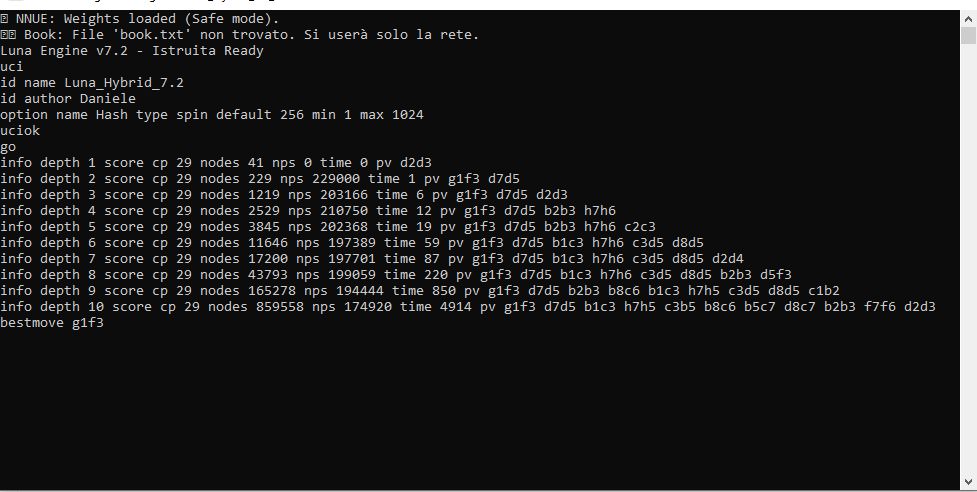
Look at the differences in the output.
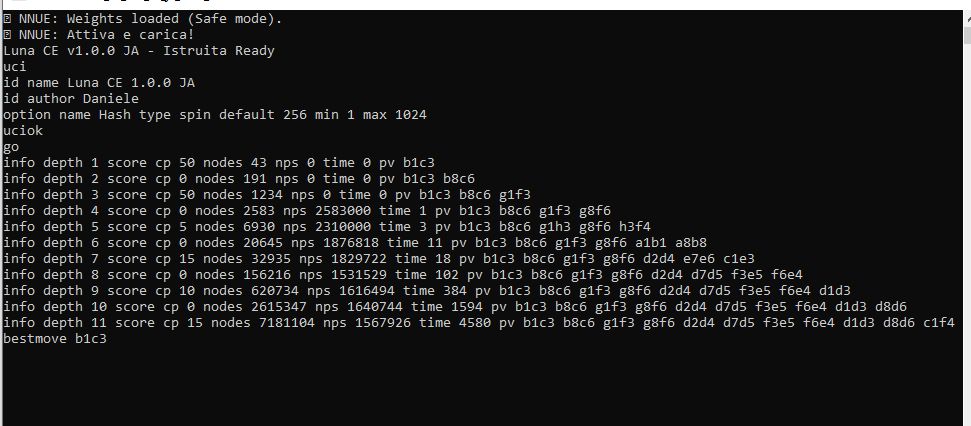
The engine with the corrected search.rs code:
-
Spunc595
- Posts: 19
- Joined: Mon Jul 06, 2026 12:15 am
- Full name: Daniele Marpino
Re: Introducing Luna: My Rust-based NNUE Chess Engine
Hi everyone,
A huge thanks to Jim for the fantastic compilation work and to Sylwy for catching the bug! You are right, the engine is currently playing without the NNUE active in the search.
I'm heading to work now for the night shift, but tomorrow I will release a patch to fix search.rs so the NNUE works correctly. I will also add the exact build instructions and environment details for anyone who wants to compile the source code themselves.
Thanks for the patience and the great feedback!
A huge thanks to Jim for the fantastic compilation work and to Sylwy for catching the bug! You are right, the engine is currently playing without the NNUE active in the search.
I'm heading to work now for the night shift, but tomorrow I will release a patch to fix search.rs so the NNUE works correctly. I will also add the exact build instructions and environment details for anyone who wants to compile the source code themselves.
Thanks for the patience and the great feedback!
-
Gabor Szots
- Posts: 1586
- Joined: Sat Jul 21, 2018 7:43 am
- Location: Budapest, Hungary
- Full name: Gabor Szots
Re: Introducing Luna: My Rust-based NNUE Chess Engine
Normally Rust sources are very easy to compile. Yours was the first one with which I failed. Please make sure that the source you release together with the executable is compilable and the two correspond with each other. I guess what Jim compiled was not the source that is under Releases.Spunc595 wrote: ↑Mon Jul 13, 2026 8:19 pm Hi everyone,
A huge thanks to Jim for the fantastic compilation work and to Sylwy for catching the bug! You are right, the engine is currently playing without the NNUE active in the search.
I'm heading to work now for the night shift, but tomorrow I will release a patch to fix search.rs so the NNUE works correctly. I will also add the exact build instructions and environment details for anyone who wants to compile the source code themselves.
Thanks for the patience and the great feedback!
Gabor Szots
CCRL testing group
CCRL testing group
-
Spunc595
- Posts: 19
- Joined: Mon Jul 06, 2026 12:15 am
- Full name: Daniele Marpino
Re: Introducing Luna: My Rust-based NNUE Chess Engine
Hi Gabor,
Thank you for bringing this to my attention. You were absolutely right. There was a mismatch in the previous release between the pre-compiled executables and the source code zip generated by GitHub, which caused the compilation failure on your end.
I have just completely synchronized my local folder with the GitHub repository and published a new release.
The new release includes:
A 100% clean and compilable source code zip.
A critical fix in search.rs (the engine is now correctly calling the NNUE evaluation during the search and quiescence, whereas before it was falling back to the classical evaluation).
Pre-compiled binaries for Windows and Android (aarch64).
You can find everything perfectly aligned here: https://github.com/Spunc595/Luna-Chess- ... tag/v1.1.0
Thanks again for testing Luna and for your patience!
Best regards,
Daniele
Thank you for bringing this to my attention. You were absolutely right. There was a mismatch in the previous release between the pre-compiled executables and the source code zip generated by GitHub, which caused the compilation failure on your end.
I have just completely synchronized my local folder with the GitHub repository and published a new release.
The new release includes:
A 100% clean and compilable source code zip.
A critical fix in search.rs (the engine is now correctly calling the NNUE evaluation during the search and quiescence, whereas before it was falling back to the classical evaluation).
Pre-compiled binaries for Windows and Android (aarch64).
You can find everything perfectly aligned here: https://github.com/Spunc595/Luna-Chess- ... tag/v1.1.0
Thanks again for testing Luna and for your patience!
Best regards,
Daniele
-
Spunc595
- Posts: 19
- Joined: Mon Jul 06, 2026 12:15 am
- Full name: Daniele Marpino
Re: Introducing Luna: My Rust-based NNUE Chess Engine
Hi Gabor,
Following up on my previous message, I am glad we sorted out the compilation issue and that the repository is now fully aligned.
However, after running some deeper tests on the new release, I have to be honest: I am seeing a massive performance drop (in terms of NPS and search depth) compared to the classical evaluation version I had before. While the engine is technically "NNUE-enabled" and functional, the speed decrease is significant enough that it seems to be hindering the engine's strength rather than helping it.
Being a self-taught developer, I suspect I have a bottleneck in my implementation—perhaps I'm missing some crucial optimization or not handling the NNUE updates correctly.
Since you have seen countless engines and implementations, would you or anyone else here be willing to share some pointers on where a newcomer should look to optimize NNUE integration? I am eager to learn and fix this, but I'm currently hitting a wall.
Thanks again for your time and for testing Luna!
Best regards,
Daniele
Following up on my previous message, I am glad we sorted out the compilation issue and that the repository is now fully aligned.
However, after running some deeper tests on the new release, I have to be honest: I am seeing a massive performance drop (in terms of NPS and search depth) compared to the classical evaluation version I had before. While the engine is technically "NNUE-enabled" and functional, the speed decrease is significant enough that it seems to be hindering the engine's strength rather than helping it.
Being a self-taught developer, I suspect I have a bottleneck in my implementation—perhaps I'm missing some crucial optimization or not handling the NNUE updates correctly.
Since you have seen countless engines and implementations, would you or anyone else here be willing to share some pointers on where a newcomer should look to optimize NNUE integration? I am eager to learn and fix this, but I'm currently hitting a wall.
Thanks again for your time and for testing Luna!
Best regards,
Daniele
-
Jim Ablett
- Posts: 2554
- Joined: Fri Jul 14, 2006 7:56 am
- Location: London, England
- Full name: Jim Ablett
Re: Introducing Luna: My Rust-based NNUE Chess Engine
SIMD-accelerated NNUE AVX2 implementation (8x faster) with scalar fallback (drop-in replacement) >Spunc595 wrote: ↑Tue Jul 14, 2026 7:54 pm Hi Gabor,
Following up on my previous message, I am glad we sorted out the compilation issue and that the repository is now fully aligned.
However, after running some deeper tests on the new release, I have to be honest: I am seeing a massive performance drop (in terms of NPS and search depth) compared to the classical evaluation version I had before. While the engine is technically "NNUE-enabled" and functional, the speed decrease is significant enough that it seems to be hindering the engine's strength rather than helping it.
Being a self-taught developer, I suspect I have a bottleneck in my implementation—perhaps I'm missing some crucial optimization or not handling the NNUE updates correctly.
Since you have seen countless engines and implementations, would you or anyone else here be willing to share some pointers on where a newcomer should look to optimize NNUE integration? I am eager to learn and fix this, but I'm currently hitting a wall.
Thanks again for your time and for testing Luna!
Best regards,
Daniele
Code: Select all
// Nnue.rs
use std::fs::File;
use std::io::Read;
use crate::board::{Scacchiera, Colore};
// --- NNUE ARCHITECTURE CONFIGURATION ---
// 768 input features (12 piece types * 64 squares).
const INPUT_SIZE: usize = 768;
// Size of the first hidden layer (Feature Transformer).
const L1_SIZE: usize = 256;
// Size of the second hidden layer.
const L2_SIZE: usize = 32;
// ============================================================================
// SIMD BACKEND SELECTION
// ============================================================================
// The hot path of NNUE inference is:
// 1) L1 accumulation: for every occupied square, add a 256-wide i16 row
// from the weight matrix into the accumulator (saturating).
// 2) CReLU clamp of the 256-wide accumulator.
// 3) L2: a 256x32 mat-vec product (i16 x i16 -> i32).
// 4) L3: a 32-wide dot product.
//
// All four steps are data-parallel over contiguous i16 arrays, which is the
// textbook case for SIMD. We provide:
// - an AVX2 implementation (x86_64, runtime-detected via CPUID, cached),
// - a NEON implementation (aarch64, always available on that target),
// - a portable scalar fallback used anywhere else, or if AVX2 is missing.
//
// Every SIMD routine has a scalar twin computing the identical arithmetic
// (same saturation points, same integer division/clamping), so switching
// backends never changes the evaluation output.
// ============================================================================
#[cfg(target_arch = "x86_64")]
fn has_avx2() -> bool {
use std::sync::OnceLock;
static AVX2: OnceLock<bool> = OnceLock::new();
*AVX2.get_or_init(|| is_x86_feature_detected!("avx2"))
}
/// Main structure for the quantized LunaNNUE neural network.
/// Stores weights and biases as 16-bit integers (`i16`) to optimize performance on CPUs without an FPU.
pub struct LunaNNUE {
l1_weights: Vec<i16>,
l1_bias: Vec<i16>,
l2_weights: Vec<i16>,
l2_bias: Vec<i16>,
l3_weights: Vec<i16>,
l3_bias: Vec<i16>,
}
impl LunaNNUE {
/// Loads the network's binary weights from an external file in Little-Endian format.
/// Returns `None` in case of I/O error or corrupted file.
pub fn load(path: &str) -> Option<Self> {
let mut file = File::open(path).ok()?;
let mut buffer = Vec::new();
file.read_to_end(&mut buffer).ok()?;
let mut net = LunaNNUE {
l1_weights: vec![0; INPUT_SIZE * L1_SIZE],
l1_bias: vec![0; L1_SIZE],
l2_weights: vec![0; L1_SIZE * L2_SIZE],
l2_bias: vec![0; L2_SIZE],
l3_weights: vec![0; L2_SIZE],
l3_bias: vec![0; 1],
};
let mut offset = 0;
// Helper closure to read paired bytes sequentially and convert them into i16.
let mut read_i16 = |count: usize| -> Vec<i16> {
let mut v = Vec::with_capacity(count);
for _ in 0..count {
if offset + 2 <= buffer.len() {
v.push(i16::from_le_bytes([buffer[offset], buffer[offset + 1]]));
offset += 2;
}
}
v
};
// Ordered mapping of weight and bias vectors.
net.l1_weights = read_i16(INPUT_SIZE * L1_SIZE);
net.l1_bias = read_i16(L1_SIZE);
net.l2_weights = read_i16(L1_SIZE * L2_SIZE);
net.l2_bias = read_i16(L2_SIZE);
net.l3_weights = read_i16(L2_SIZE);
net.l3_bias = read_i16(1);
// Initial diagnostic check on the binary file status.
if net.l1_weights.iter().take(100).all(|&x| x == 0) {
println!("⚠️ WARNING: The NNUE file seems empty!");
} else {
#[cfg(target_arch = "x86_64")]
let backend = if has_avx2() { "AVX2" } else { "scalar" };
#[cfg(target_arch = "aarch64")]
let backend = "NEON";
#[cfg(not(any(target_arch = "x86_64", target_arch = "aarch64")))]
let backend = "scalar";
println!("✅ NNUE: Weights loaded (Safe mode, {} backend).", backend);
}
Some(net)
}
/// Performs the feedforward (inference) step of the network for the current position.
/// Extracts active features via bitboards and propagates values through quantized layers.
pub fn evaluate(&self, s: &Scacchiera) -> i32 {
// ==========================================
// --- LAYER 1: FEATURE TRANSFORMER (QA=255)
// ==========================================
// Initialize the L1 accumulator by cloning the initial bias values.
let mut l1_acc = [0i16; L1_SIZE];
l1_acc.copy_from_slice(&self.l1_bias);
// Iterate over the 6 piece types.
for p_idx in 0..6 {
// Sub-step for White (Color Index 0).
let mut bb_w = s.pezzi[p_idx] & s.colori[0];
while bb_w != 0 {
let sq = bb_w.trailing_zeros() as usize;
let offset = (p_idx * 64 + sq) * L1_SIZE;
simd::accumulate(&mut l1_acc, &self.l1_weights[offset..offset + L1_SIZE]);
bb_w &= bb_w - 1; // Clear the processed bit (Bit-pop)
}
// Sub-step for Black (Color Index 1).
// Black pieces are shifted by 6 positions in the feature index (+6).
let mut bb_b = s.pezzi[p_idx] & s.colori[1];
while bb_b != 0 {
let sq = bb_b.trailing_zeros() as usize;
let offset = ((p_idx + 6) * 64 + sq) * L1_SIZE;
simd::accumulate(&mut l1_acc, &self.l1_weights[offset..offset + L1_SIZE]);
bb_b &= bb_b - 1;
}
}
// Apply CReLU activation function on Layer 1.
// The ceiling is limited to 2048, consistent with the QA=255 scale.
let mut l1_out = [0i16; L1_SIZE];
simd::crelu(&l1_acc, &mut l1_out, 2048);
// ==========================================
// --- LAYER 2: HIDDEN LAYER (QB=64)
// ==========================================
let mut l2_acc = [0i32; L2_SIZE];
simd::forward_l2(&l1_out, &self.l2_weights, &self.l2_bias, &mut l2_acc);
// CReLU activation function on Layer 2.
// The ceiling is set to 128 to respect the QB=64 quantization scale.
let mut l2_out = [0i16; L2_SIZE];
for i in 0..L2_SIZE {
l2_out[i] = l2_acc[i].clamp(0, 128) as i16;
}
// ==========================================
// --- LAYER 3: LINEAR OUTPUT
// ==========================================
let score = self.l3_bias[0] as i32
+ simd::weighted_sum_div_pow2(&l2_out, &self.l3_weights, 8); // /256 = >>8
// Synchronize output with the Negamax search perspective.
if s.turno == Colore::Bianco { score } else { -score }
}
}
// ============================================================================
// SIMD implementations
// ============================================================================
mod simd {
use super::{L1_SIZE, L2_SIZE};
/// acc[i] = saturating_add(acc[i], weights[i]) for i in 0..L1_SIZE
#[inline(always)]
pub fn accumulate(acc: &mut [i16; L1_SIZE], weights: &[i16]) {
debug_assert_eq!(weights.len(), L1_SIZE);
#[cfg(target_arch = "x86_64")]
{
if super::has_avx2() {
unsafe { x86::accumulate_avx2(acc, weights) };
return;
}
}
#[cfg(target_arch = "aarch64")]
{
unsafe { arm::accumulate_neon(acc, weights) };
return;
}
#[allow(unreachable_code)]
accumulate_scalar(acc, weights);
}
#[inline(always)]
#[allow(dead_code)]
fn accumulate_scalar(acc: &mut [i16; L1_SIZE], weights: &[i16]) {
for i in 0..L1_SIZE {
acc[i] = acc[i].saturating_add(weights[i]);
}
}
/// out[i] = clamp(acc[i], 0, ceiling)
#[inline(always)]
pub fn crelu(acc: &[i16; L1_SIZE], out: &mut [i16; L1_SIZE], ceiling: i16) {
#[cfg(target_arch = "x86_64")]
{
if super::has_avx2() {
unsafe { x86::crelu_avx2(acc, out, ceiling) };
return;
}
}
#[cfg(target_arch = "aarch64")]
{
unsafe { arm::crelu_neon(acc, out, ceiling) };
return;
}
#[allow(unreachable_code)]
crelu_scalar(acc, out, ceiling);
}
#[inline(always)]
#[allow(dead_code)]
fn crelu_scalar(acc: &[i16; L1_SIZE], out: &mut [i16; L1_SIZE], ceiling: i16) {
for i in 0..L1_SIZE {
out[i] = acc[i].clamp(0, ceiling);
}
}
/// acc2[o] = bias[o] + sum_j( l1_out[j] * weights[j * L2_SIZE + o] ) / 2048
/// (weights are laid out row-major: row j, L2_SIZE contiguous columns)
#[inline(always)]
pub fn forward_l2(
l1_out: &[i16; L1_SIZE],
weights: &[i16],
bias: &[i16],
acc2: &mut [i32; L2_SIZE],
) {
debug_assert_eq!(weights.len(), L1_SIZE * L2_SIZE);
debug_assert_eq!(bias.len(), L2_SIZE);
#[cfg(target_arch = "x86_64")]
{
if super::has_avx2() && L2_SIZE == 32 {
unsafe { x86::forward_l2_avx2(l1_out, weights, bias, acc2) };
return;
}
}
#[cfg(target_arch = "aarch64")]
{
unsafe { arm::forward_l2_neon(l1_out, weights, bias, acc2) };
return;
}
#[allow(unreachable_code)]
forward_l2_scalar(l1_out, weights, bias, acc2);
}
#[inline(always)]
#[allow(dead_code)]
fn forward_l2_scalar(
l1_out: &[i16; L1_SIZE],
weights: &[i16],
bias: &[i16],
acc2: &mut [i32; L2_SIZE],
) {
for i in 0..L2_SIZE {
acc2[i] = bias[i] as i32;
}
for j in 0..L1_SIZE {
let lj = l1_out[j] as i32;
if lj == 0 {
continue; // CReLU sparsity: skip zeroed activations
}
let row = &weights[j * L2_SIZE..j * L2_SIZE + L2_SIZE];
for i in 0..L2_SIZE {
acc2[i] += (lj * row[i] as i32) / 2048;
}
}
}
/// sum_i( truncating_div(a[i] * b[i], 2^shift) )
///
/// NOTE: this deliberately divides *each term* before summing, matching
/// the reference scalar loop `score += (a[i]*b[i]) / divisor`. Integer
/// truncating division does not distribute over addition for negative
/// operands (e.g. (-1)/2 + (-1)/2 == 0 but (-2)/2 == -1), so summing the
/// raw products first and dividing once would silently change the score.
#[inline(always)]
pub fn weighted_sum_div_pow2(a: &[i16], b: &[i16], shift: u32) -> i32 {
debug_assert_eq!(a.len(), b.len());
#[cfg(target_arch = "x86_64")]
{
if super::has_avx2() && a.len() % 16 == 0 {
return unsafe { x86::weighted_sum_div_pow2_avx2(a, b, shift) };
}
}
#[cfg(target_arch = "aarch64")]
{
return unsafe { arm::weighted_sum_div_pow2_neon(a, b, shift) };
}
#[allow(unreachable_code)]
weighted_sum_div_pow2_scalar(a, b, shift)
}
#[inline(always)]
#[allow(dead_code)]
fn weighted_sum_div_pow2_scalar(a: &[i16], b: &[i16], shift: u32) -> i32 {
let divisor = 1i32 << shift;
let mut sum = 0i32;
for i in 0..a.len() {
sum += (a[i] as i32 * b[i] as i32) / divisor;
}
sum
}
// ------------------------------------------------------------------
// x86_64 / AVX2 backend
// ------------------------------------------------------------------
#[cfg(target_arch = "x86_64")]
mod x86 {
use super::{L1_SIZE, L2_SIZE};
use std::arch::x86_64::*;
#[target_feature(enable = "avx2")]
pub unsafe fn accumulate_avx2(acc: &mut [i16; L1_SIZE], weights: &[i16]) {
// 16 x i16 lanes per __m256i -> L1_SIZE / 16 iterations.
let mut i = 0;
while i < L1_SIZE {
let a = _mm256_loadu_si256(acc.as_ptr().add(i) as *const __m256i);
let w = _mm256_loadu_si256(weights.as_ptr().add(i) as *const __m256i);
let sum = _mm256_adds_epi16(a, w); // saturating add, matches i16::saturating_add
_mm256_storeu_si256(acc.as_mut_ptr().add(i) as *mut __m256i, sum);
i += 16;
}
}
#[target_feature(enable = "avx2")]
pub unsafe fn crelu_avx2(acc: &[i16; L1_SIZE], out: &mut [i16; L1_SIZE], ceiling: i16) {
let zero = _mm256_setzero_si256();
let cap = _mm256_set1_epi16(ceiling);
let mut i = 0;
while i < L1_SIZE {
let a = _mm256_loadu_si256(acc.as_ptr().add(i) as *const __m256i);
let clamped = _mm256_min_epi16(_mm256_max_epi16(a, zero), cap);
_mm256_storeu_si256(out.as_mut_ptr().add(i) as *mut __m256i, clamped);
i += 16;
}
}
/// Truncating (round-toward-zero) division of each i32 lane by 2^shift,
/// matching Rust's `/` operator for i32 (as opposed to an arithmetic
/// shift, which rounds toward negative infinity for negative inputs).
/// Uses the variable-count shift intrinsics since `shift` is a runtime
/// value here (the immediate-shift intrinsics require a compile-time
/// constant).
#[target_feature(enable = "avx2")]
unsafe fn div_pow2_trunc(x: __m256i, shift: u32) -> __m256i {
let sign = _mm256_srai_epi32(x, 31); // all-1s if negative, else all-0s (31 is a literal immediate)
let bias = _mm256_srl_epi32(sign, _mm_cvtsi32_si128((32 - shift) as i32));
let biased = _mm256_add_epi32(x, bias);
_mm256_sra_epi32(biased, _mm_cvtsi32_si128(shift as i32))
}
/// Outer-product accumulation: for each active (non-zero) input feature j,
/// broadcast l1_out[j], multiply by the corresponding 32-wide weight row,
/// divide *each* resulting term by 2048 (matching the scalar reference's
/// per-term division), then accumulate into a 32-lane i32 accumulator
/// (4 x __m256i of 8 lanes).
#[target_feature(enable = "avx2")]
pub unsafe fn forward_l2_avx2(
l1_out: &[i16; L1_SIZE],
weights: &[i16],
bias: &[i16],
acc2: &mut [i32; L2_SIZE],
) {
let mut acc0 = _mm256_setzero_si256();
let mut acc1 = _mm256_setzero_si256();
let mut acc2v = _mm256_setzero_si256();
let mut acc3 = _mm256_setzero_si256();
for j in 0..L1_SIZE {
let lj = l1_out[j];
if lj == 0 {
continue; // CReLU sparsity: skip zeroed activations
}
let broadcast = _mm256_set1_epi32(lj as i32);
let row_ptr = weights.as_ptr().add(j * L2_SIZE);
// Widen 4 groups of 8 x i16 -> 8 x i32, multiply, divide, accumulate.
let w0 = _mm256_cvtepi16_epi32(_mm_loadu_si128(row_ptr as *const __m128i));
let w1 = _mm256_cvtepi16_epi32(_mm_loadu_si128(row_ptr.add(8) as *const __m128i));
let w2 = _mm256_cvtepi16_epi32(_mm_loadu_si128(row_ptr.add(16) as *const __m128i));
let w3 = _mm256_cvtepi16_epi32(_mm_loadu_si128(row_ptr.add(24) as *const __m128i));
let p0 = div_pow2_trunc(_mm256_mullo_epi32(broadcast, w0), 11);
let p1 = div_pow2_trunc(_mm256_mullo_epi32(broadcast, w1), 11);
let p2 = div_pow2_trunc(_mm256_mullo_epi32(broadcast, w2), 11);
let p3 = div_pow2_trunc(_mm256_mullo_epi32(broadcast, w3), 11);
acc0 = _mm256_add_epi32(acc0, p0);
acc1 = _mm256_add_epi32(acc1, p1);
acc2v = _mm256_add_epi32(acc2v, p2);
acc3 = _mm256_add_epi32(acc3, p3);
}
let mut raw = [0i32; L2_SIZE];
_mm256_storeu_si256(raw.as_mut_ptr().add(0) as *mut __m256i, acc0);
_mm256_storeu_si256(raw.as_mut_ptr().add(8) as *mut __m256i, acc1);
_mm256_storeu_si256(raw.as_mut_ptr().add(16) as *mut __m256i, acc2v);
_mm256_storeu_si256(raw.as_mut_ptr().add(24) as *mut __m256i, acc3);
for i in 0..L2_SIZE {
acc2[i] = bias[i] as i32 + raw[i];
}
}
/// sum_i( truncating_div(a[i]*b[i], 2^shift) ), see the scalar twin
/// `weighted_sum_div_pow2_scalar` for the exact semantics preserved here.
#[target_feature(enable = "avx2")]
pub unsafe fn weighted_sum_div_pow2_avx2(a: &[i16], b: &[i16], shift: u32) -> i32 {
let mut acc = _mm256_setzero_si256();
let mut i = 0;
while i + 16 <= a.len() {
let va = _mm256_loadu_si256(a.as_ptr().add(i) as *const __m256i);
let vb = _mm256_loadu_si256(b.as_ptr().add(i) as *const __m256i);
// Widen the low/high 8 x i16 lanes to i32 so each product can be
// divided individually before summation (matches scalar order).
let va_lo = _mm256_cvtepi16_epi32(_mm256_castsi256_si128(va));
let va_hi = _mm256_cvtepi16_epi32(_mm256_extracti128_si256(va, 1));
let vb_lo = _mm256_cvtepi16_epi32(_mm256_castsi256_si128(vb));
let vb_hi = _mm256_cvtepi16_epi32(_mm256_extracti128_si256(vb, 1));
let prod_lo = div_pow2_trunc(_mm256_mullo_epi32(va_lo, vb_lo), shift);
let prod_hi = div_pow2_trunc(_mm256_mullo_epi32(va_hi, vb_hi), shift);
acc = _mm256_add_epi32(acc, prod_lo);
acc = _mm256_add_epi32(acc, prod_hi);
i += 16;
}
let mut sum = hsum_epi32(acc);
let divisor = 1i32 << shift;
while i < a.len() {
sum += (a[i] as i32 * b[i] as i32) / divisor;
i += 1;
}
sum
}
#[target_feature(enable = "avx2")]
unsafe fn hsum_epi32(v: __m256i) -> i32 {
let hi = _mm256_extracti128_si256(v, 1);
let lo = _mm256_castsi256_si128(v);
let sum128 = _mm_add_epi32(hi, lo);
let hi64 = _mm_unpackhi_epi64(sum128, sum128);
let sum64 = _mm_add_epi32(sum128, hi64);
let hi32 = _mm_shuffle_epi32(sum64, 0b01);
let sum32 = _mm_add_epi32(sum64, hi32);
_mm_cvtsi128_si32(sum32)
}
}
// ------------------------------------------------------------------
// aarch64 / NEON backend
// ------------------------------------------------------------------
#[cfg(target_arch = "aarch64")]
mod arm {
use super::{L1_SIZE, L2_SIZE};
use std::arch::aarch64::*;
#[target_feature(enable = "neon")]
pub unsafe fn accumulate_neon(acc: &mut [i16; L1_SIZE], weights: &[i16]) {
// 8 x i16 lanes per 128-bit vector -> L1_SIZE / 8 iterations.
let mut i = 0;
while i < L1_SIZE {
let a = vld1q_s16(acc.as_ptr().add(i));
let w = vld1q_s16(weights.as_ptr().add(i));
let sum = vqaddq_s16(a, w); // saturating add
vst1q_s16(acc.as_mut_ptr().add(i), sum);
i += 8;
}
}
#[target_feature(enable = "neon")]
pub unsafe fn crelu_neon(acc: &[i16; L1_SIZE], out: &mut [i16; L1_SIZE], ceiling: i16) {
let zero = vdupq_n_s16(0);
let cap = vdupq_n_s16(ceiling);
let mut i = 0;
while i < L1_SIZE {
let a = vld1q_s16(acc.as_ptr().add(i));
let clamped = vminq_s16(vmaxq_s16(a, zero), cap);
vst1q_s16(out.as_mut_ptr().add(i), clamped);
i += 8;
}
}
/// Truncating (round-toward-zero) division of each i32 lane by 2^shift,
/// matching Rust's `/` operator for i32. Uses variable-count shifts
/// (vshlq_* with a negative amount shifts right) since `shift` is a
/// runtime value; the `vshrq_n_*` intrinsics require a compile-time
/// constant immediate.
#[target_feature(enable = "neon")]
unsafe fn div_pow2_trunc(x: int32x4_t, shift: i32) -> int32x4_t {
let sign = vshrq_n_s32(x, 31); // 31 is a literal immediate: all-1s if negative, else all-0s
let sign_u = vreinterpretq_u32_s32(sign);
let neg_amt = vdupq_n_s32(-(32 - shift));
let bias_u = vshlq_u32(sign_u, neg_amt); // negative amount => logical right shift
let bias = vreinterpretq_s32_u32(bias_u);
let biased = vaddq_s32(x, bias);
vshlq_s32(biased, vdupq_n_s32(-shift)) // negative amount => arithmetic right shift
}
#[target_feature(enable = "neon")]
pub unsafe fn forward_l2_neon(
l1_out: &[i16; L1_SIZE],
weights: &[i16],
bias: &[i16],
acc2: &mut [i32; L2_SIZE],
) {
// 4 lanes of i32 per vector -> L2_SIZE / 4 accumulators.
let mut accs = [vdupq_n_s32(0); L2_SIZE / 4];
for j in 0..L1_SIZE {
let lj = l1_out[j];
if lj == 0 {
continue;
}
let broadcast = vdupq_n_s32(lj as i32);
let row_ptr = weights.as_ptr().add(j * L2_SIZE);
for k in 0..(L2_SIZE / 4) {
let w16 = vld1_s16(row_ptr.add(k * 4));
let w32 = vmovl_s16(w16); // widen 4 x i16 -> 4 x i32
let prod = vmulq_s32(broadcast, w32);
accs[k] = vaddq_s32(accs[k], div_pow2_trunc(prod, 11));
}
}
let mut raw = [0i32; L2_SIZE];
for k in 0..(L2_SIZE / 4) {
vst1q_s32(raw.as_mut_ptr().add(k * 4), accs[k]);
}
for i in 0..L2_SIZE {
acc2[i] = bias[i] as i32 + raw[i];
}
}
/// sum_i( truncating_div(a[i]*b[i], 2^shift) ), see the scalar twin
/// `weighted_sum_div_pow2_scalar` for the exact semantics preserved here.
#[target_feature(enable = "neon")]
pub unsafe fn weighted_sum_div_pow2_neon(a: &[i16], b: &[i16], shift: u32) -> i32 {
let mut acc = vdupq_n_s32(0);
let mut i = 0;
let len = a.len();
while i + 8 <= len {
let va = vld1q_s16(a.as_ptr().add(i));
let vb = vld1q_s16(b.as_ptr().add(i));
let lo = vmull_s16(vget_low_s16(va), vget_low_s16(vb));
let hi = vmull_s16(vget_high_s16(va), vget_high_s16(vb));
acc = vaddq_s32(acc, div_pow2_trunc(lo, shift as i32));
acc = vaddq_s32(acc, div_pow2_trunc(hi, shift as i32));
i += 8;
}
let mut sum = vaddvq_s32(acc);
let divisor = 1i32 << shift;
while i < len {
sum += (a[i] as i32 * b[i] as i32) / divisor;
i += 1;
}
sum
}
}
}
// ============================================================================
// Tests: every SIMD backend must match the scalar reference exactly.
// ============================================================================
#[cfg(test)]
mod tests {
use super::simd::*;
use super::{L1_SIZE, L2_SIZE};
fn rand_i16_vec(len: usize, seed: &mut u64) -> Vec<i16> {
let mut v = Vec::with_capacity(len);
for _ in 0..len {
*seed = seed.wrapping_mul(6364136223846793005).wrapping_add(1);
v.push(((*seed >> 48) as i16) % 2000);
}
v
}
#[test]
fn accumulate_matches_scalar() {
let mut seed = 12345u64;
let base = rand_i16_vec(L1_SIZE, &mut seed);
let weights = rand_i16_vec(L1_SIZE, &mut seed);
let mut acc_simd = [0i16; L1_SIZE];
acc_simd.copy_from_slice(&base);
accumulate(&mut acc_simd, &weights);
let mut acc_scalar = [0i16; L1_SIZE];
acc_scalar.copy_from_slice(&base);
for i in 0..L1_SIZE {
acc_scalar[i] = acc_scalar[i].saturating_add(weights[i]);
}
assert_eq!(acc_simd, acc_scalar);
}
#[test]
fn crelu_matches_scalar() {
let mut seed = 999u64;
let acc: Vec<i16> = rand_i16_vec(L1_SIZE, &mut seed)
.iter()
.map(|&x| x.wrapping_sub(1000))
.collect();
let mut acc_arr = [0i16; L1_SIZE];
acc_arr.copy_from_slice(&acc);
let mut out_simd = [0i16; L1_SIZE];
crelu(&acc_arr, &mut out_simd, 2048);
let mut out_scalar = [0i16; L1_SIZE];
for i in 0..L1_SIZE {
out_scalar[i] = acc_arr[i].clamp(0, 2048);
}
assert_eq!(out_simd, out_scalar);
}
#[test]
fn forward_l2_matches_scalar() {
let mut seed = 42u64;
let l1_out_v: Vec<i16> = rand_i16_vec(L1_SIZE, &mut seed)
.iter()
.map(|&x| x.unsigned_abs() as i16 % 2048) // valid CReLU output range
.collect();
let mut l1_out = [0i16; L1_SIZE];
l1_out.copy_from_slice(&l1_out_v);
let weights = rand_i16_vec(L1_SIZE * L2_SIZE, &mut seed);
let bias = rand_i16_vec(L2_SIZE, &mut seed);
let mut acc_simd = [0i32; L2_SIZE];
forward_l2(&l1_out, &weights, &bias, &mut acc_simd);
let mut acc_scalar = [0i32; L2_SIZE];
for i in 0..L2_SIZE {
acc_scalar[i] = bias[i] as i32;
}
for j in 0..L1_SIZE {
let lj = l1_out[j] as i32;
if lj == 0 { continue; }
let row = &weights[j * L2_SIZE..j * L2_SIZE + L2_SIZE];
for i in 0..L2_SIZE {
acc_scalar[i] += (lj * row[i] as i32) / 2048;
}
}
assert_eq!(acc_simd, acc_scalar);
}
#[test]
fn weighted_sum_div_pow2_matches_scalar() {
let mut seed = 777u64;
// Include plenty of negative values: this is exactly the case where
// sum-then-divide would diverge from divide-then-sum.
let a = rand_i16_vec(L2_SIZE, &mut seed);
let b = rand_i16_vec(L2_SIZE, &mut seed);
let simd_result = weighted_sum_div_pow2(&a, &b, 8);
let scalar_result: i32 = a
.iter()
.zip(b.iter())
.map(|(&x, &y)| (x as i32 * y as i32) / 256)
.sum();
assert_eq!(simd_result, scalar_result);
}
#[test]
fn weighted_sum_div_pow2_matches_scalar_l1_sized() {
// Also exercise the L1_SIZE-length case (used nowhere directly today,
// but confirms the AVX2/NEON remainder-handling loop is correct for
// lengths that aren't a clean multiple of 16).
let mut seed = 2024u64;
let a = rand_i16_vec(37, &mut seed);
let b = rand_i16_vec(37, &mut seed);
let simd_result = weighted_sum_div_pow2(&a, &b, 11);
let scalar_result: i32 = a
.iter()
.zip(b.iter())
.map(|(&x, &y)| (x as i32 * y as i32) / 2048)
.sum();
assert_eq!(simd_result, scalar_result);
}
#[test]
fn stress_full_i16_range_many_trials() {
// Real quantized weights can span the full i16 range and be negative;
// hammer every primitive with 500 trials to catch rare lane/rounding bugs.
let mut seed = 0xC0FFEEu64;
let mut next = |lo: i32, hi: i32| -> i16 {
seed = seed.wrapping_mul(6364136223846793005).wrapping_add(1442695040888963407);
let r = (seed >> 33) as i64;
(lo as i64 + (r % (hi - lo + 1) as i64)) as i16
};
for _ in 0..500 {
// accumulate
let base: Vec<i16> = (0..L1_SIZE).map(|_| next(-32000, 32000)).collect();
let weights: Vec<i16> = (0..L1_SIZE).map(|_| next(i16::MIN as i32, i16::MAX as i32)).collect();
let mut a1 = [0i16; L1_SIZE];
a1.copy_from_slice(&base);
accumulate(&mut a1, &weights);
let mut a2 = [0i16; L1_SIZE];
a2.copy_from_slice(&base);
for i in 0..L1_SIZE { a2[i] = a2[i].saturating_add(weights[i]); }
assert_eq!(a1, a2, "accumulate mismatch");
// crelu
let mut c1 = [0i16; L1_SIZE];
crelu(&a1, &mut c1, 2048);
let mut c2 = [0i16; L1_SIZE];
for i in 0..L1_SIZE { c2[i] = a1[i].clamp(0, 2048); }
assert_eq!(c1, c2, "crelu mismatch");
// forward_l2 (c1 is a valid 0..=2048 CReLU output)
let l2w: Vec<i16> = (0..L1_SIZE * L2_SIZE).map(|_| next(i16::MIN as i32, i16::MAX as i32)).collect();
let l2b: Vec<i16> = (0..L2_SIZE).map(|_| next(i16::MIN as i32, i16::MAX as i32)).collect();
let mut l2acc1 = [0i32; L2_SIZE];
forward_l2(&c1, &l2w, &l2b, &mut l2acc1);
let mut l2acc2 = [0i32; L2_SIZE];
for i in 0..L2_SIZE { l2acc2[i] = l2b[i] as i32; }
for j in 0..L1_SIZE {
let lj = c1[j] as i32;
if lj == 0 { continue; }
for i in 0..L2_SIZE {
l2acc2[i] += (lj * l2w[j * L2_SIZE + i] as i32) / 2048;
}
}
assert_eq!(l2acc1, l2acc2, "forward_l2 mismatch");
// weighted_sum_div_pow2 (L3-style)
let l2out: Vec<i16> = (0..L2_SIZE).map(|_| next(-32000, 32000)).collect();
let l3w: Vec<i16> = (0..L2_SIZE).map(|_| next(i16::MIN as i32, i16::MAX as i32)).collect();
let s1 = weighted_sum_div_pow2(&l2out, &l3w, 8);
let s2: i32 = l2out.iter().zip(l3w.iter()).map(|(&x, &y)| (x as i32 * y as i32) / 256).sum();
assert_eq!(s1, s2, "weighted_sum_div_pow2 mismatch");
}
}
#[test]
#[ignore]
fn bench_evaluate_throughput() {
use crate::board::Scacchiera;
use crate::zobrist::get_zobrist_keys;
use std::time::Instant;
let net = super::LunaNNUE::load("luna.nnue").expect("luna.nnue must be present for this bench");
let z = get_zobrist_keys();
let board = Scacchiera::new_iniziale(z);
let iters = 2_000_000u64;
let start = Instant::now();
let mut sink = 0i64;
for _ in 0..iters {
sink += net.evaluate(&board) as i64;
}
let elapsed = start.elapsed();
println!(
"evaluate(): {} calls in {:?} ({:.1} ns/call, {:.2} M evals/sec) [sink={}]",
iters,
elapsed,
elapsed.as_nanos() as f64 / iters as f64,
iters as f64 / elapsed.as_secs_f64() / 1e6,
sink
);
}
#[test]
fn full_forward_pass_is_deterministic() {
let mut seed = 314159u64;
let l1_out_v: Vec<i16> = rand_i16_vec(L1_SIZE, &mut seed)
.iter()
.map(|&x| x.unsigned_abs() as i16 % 2048)
.collect();
let mut l1_out = [0i16; L1_SIZE];
l1_out.copy_from_slice(&l1_out_v);
let weights = rand_i16_vec(L1_SIZE * L2_SIZE, &mut seed);
let bias = rand_i16_vec(L2_SIZE, &mut seed);
let mut a = [0i32; L2_SIZE];
let mut b = [0i32; L2_SIZE];
forward_l2(&l1_out, &weights, &bias, &mut a);
forward_l2(&l1_out, &weights, &bias, &mut b);
assert_eq!(a, b);
}
}Jim.
-
Spunc595
- Posts: 19
- Joined: Mon Jul 06, 2026 12:15 am
- Full name: Daniele Marpino
Re: Introducing Luna: My Rust-based NNUE Chess Engine
Hi Jim, thank you so much! This is incredibly generous of you. Implementing an AVX2 SIMD acceleration with scalar fallback is exactly what Luna needed to overcome the bottleneck I was seeing.
I will integrate and test the code tomorrow, and I'll definitely let you know the results. I really appreciate you taking the time to help a self-taught developer!
I will integrate and test the code tomorrow, and I'll definitely let you know the results. I really appreciate you taking the time to help a self-taught developer!