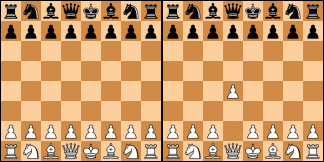
Can engines analyze this position and can white win?
Moderator: Ras
-
Uri Blass
- Posts: 11204
- Joined: Thu Mar 09, 2006 12:37 am
- Location: Tel-Aviv Israel
Can engines analyze this position and can white win?
I am not sure if white is winning and it may be a draw with correct play.
-
peter
- Posts: 3575
- Joined: Sat Feb 16, 2008 7:38 am
- Full name: Peter Martan
Re: Can engines analyze this position and can white win?
First you log in at Facebook, because link says so, then there's just the same weird picture to be seen already on screen- shot, in meantime I'm not sure anymore, if it's just a (to me) doubtfully funny joke or maybe yet meant seriously

Anyhow, one can spare logging in at Facebook, not any better pic there to be seen neither, regards
Peter.
-
jefk
- Posts: 1085
- Joined: Sun Jul 25, 2010 10:07 pm
- Location: the Netherlands
- Full name: Jef Kaan
Re: Can engines analyze this position and can white win?
it's like "infinite chess"
https://en.wikipedia.org/wiki/Infinite_chess
and it's a draw, of course obviously.
(Black has sufficient degrees of freedom to prevent any forced
win for White, thus it's a 'balanced game' thus a draw).
https://en.wikipedia.org/wiki/Infinite_chess
and it's a draw, of course obviously.
(Black has sufficient degrees of freedom to prevent any forced
win for White, thus it's a 'balanced game' thus a draw).
-
Ajedrecista
- Posts: 2229
- Joined: Wed Jul 13, 2011 9:04 pm
- Location: Madrid, Spain.
Re: Can engines analyze this position and can white win?
Hello Peter:
Perft(1) = 20 (the usual moves on 8×8) + 2·12 (rooks in the first row) + 2·1 (knights to the second row) = 46.
Perft(2) = [Perft(1)]² = 2116.
Imagine the branching factor at higher depths. More generally, in a N×N chessboard (N even and N > 8) with the pieces centered with respect of the columns and no rows behind the major pieces:
Perft(1) = 20 + (N - 8) + 2 = N + 14.
Perft(2) = [Perft(1)]² = (N + 14)² = N² + 28·N + 196 (order of N² with big N).
Even the N queens puzzle is unsolved nowadays for 28×28 onwards (links to OEIS and Wikipedia).
Regards from Spain.
Ajedrecista.
Pointless, unfunny joke for me. I see that it is a 32×32 chessboard. Assuming the same moves than standard chess:
Perft(1) = 20 (the usual moves on 8×8) + 2·12 (rooks in the first row) + 2·1 (knights to the second row) = 46.
Perft(2) = [Perft(1)]² = 2116.
Imagine the branching factor at higher depths. More generally, in a N×N chessboard (N even and N > 8) with the pieces centered with respect of the columns and no rows behind the major pieces:
Perft(1) = 20 + (N - 8) + 2 = N + 14.
Perft(2) = [Perft(1)]² = (N + 14)² = N² + 28·N + 196 (order of N² with big N).
Even the N queens puzzle is unsolved nowadays for 28×28 onwards (links to OEIS and Wikipedia).
Regards from Spain.
Ajedrecista.